
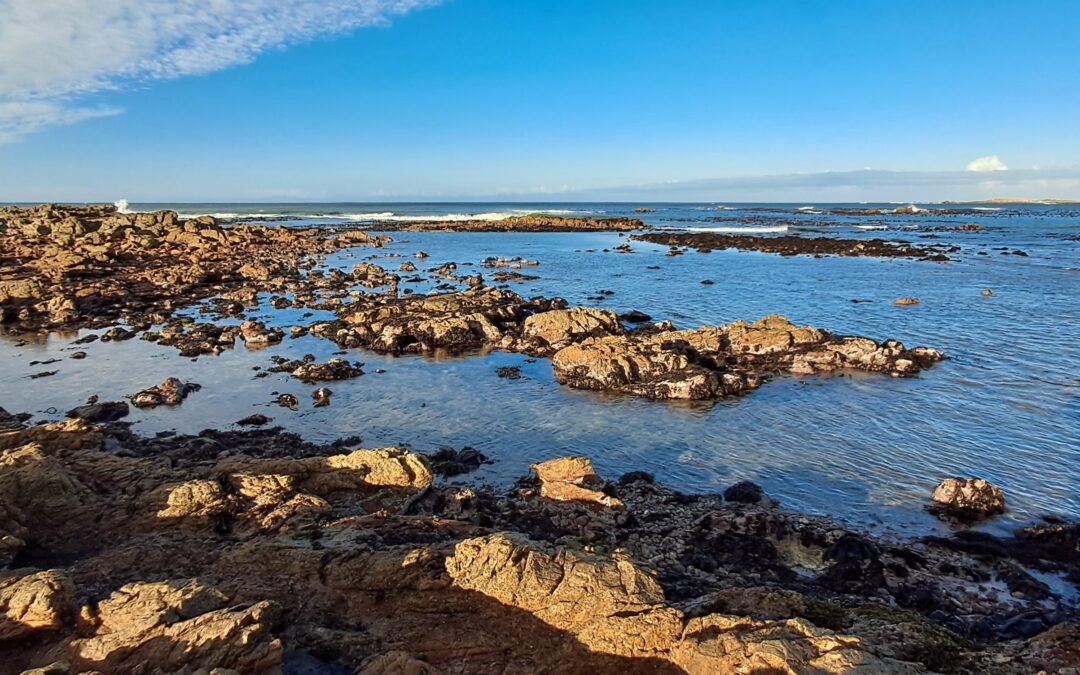
Along the rugged coastline of South Africa, evidence of human life stretches back thousands of years. Hidden among rocky shores, sandy beaches, and windswept cliffs are clues to how early coastal communities survived and thrived. Three important features tell this story: Strandlopers, fish traps, and middens. Together, they provide a fascinating glimpse into the lives of people who depended on the sea long before modern fishing boats and supermarkets existed.
Who Were the Strandlopers?
The term “Strandloper” is derived from Afrikaans and means “beach walker” or “shore walker.” Historically, it was used by European settlers to describe indigenous hunter-gatherer communities who lived along the southern and western coasts of South Africa. These people were not a distinct tribe but rather groups of Khoisan-speaking people who adapted to life along the shoreline.
The Khoisan are the non Bantu indigenous people of Southern Africa. They include the Khoikhoi (pastoralists) and the San (hunter gatherers). The Dutch settlers referred to the Khoikhoi as “Hottentot” and the San as “Bosman” (bushman). “Hottentot” is an onomatopoeic term referring to the click consonants prevalent in the Khoikhoi languages. Khoi means “first man” and San means “forager not owning livestock”.
DNA studies on modern Khoisan people suggest that some of them are direct descendants of very early anatomically modern humans who first populated the area 150 000 – 260 000 years ago. This timing can be compared with the peopling of Eurasia 70 000 years ago and other parts of the globe as recently as 20 000 years ago.
By 130 000 years ago, there were two distinct groups of anatomically modern humans coexisting in Africa – the ancestors of many modern Khoisan in Southern Africa, and a group in Central and East Africa that includes the ancestors of most extant world populations.
With the arrival of the Bantu tribes from East Africa 1500-2000 years ago, the Khoisan were decimated and were displaced into the drier desert areas. By the time the Dutch arrived in the Cape in 1652, the San were living as hunter gatherers and the Khoikhoi as pastoralists, keeping goats, sheep, and cattle. With the arrival of the Europeans, repeated measles and small pox epidemics, colonial expansion, and land seizures damaged and destroyed their social organization. Some settled on Dutch farms as bondsmen, some were incorporated into Xhosa family groups, and some intermarried with the Europeans.
The Strandlopers relied heavily on marine resources. The ocean provided fish, shellfish, seals, seabirds, and occasionally stranded whales. Coastal plants supplemented their diet, while hunting inland animals provided additional food and materials. Their intimate knowledge of tides, seasons, and marine ecosystems allowed them to survive in an environment that could be both rich and unpredictable.
Today, archaeologists prefer to refer to these communities as Later Stone Age coastal hunter-gatherers rather than using the term Strandloper, which can oversimplify the diversity of the people who lived along the coast. Nevertheless, the word remains deeply embedded in South African heritage.
Ancient Fish Traps: Ingenious Coastal Engineering
One of the most remarkable legacies left behind by these early coastal inhabitants is the network of stone fish traps found along parts of South Africa’s coastline, and Penguin Trail hikers can see fish traps in Mast Bay on their hike from Cape Hangklip to Silversands Beach.
Fish traps are simple yet highly effective structures built from rocks arranged in circular or semi-circular walls within the intertidal zone. At high tide, fish swim over the walls and into the enclosed area. As the tide recedes, the fish become trapped in shallow pools, making them easy to collect.
These traps demonstrate a sophisticated understanding of tidal movements and fish behaviour. They required careful placement and often collective effort to build and maintain. In many ways, they represent an early form of sustainable fishing. Unlike large-scale modern fishing methods, fish traps allowed communities to harvest food without significantly damaging marine ecosystems.
Some fish traps may be hundreds or even thousands of years old. During the last Ice Age, which ended about 10 000 years ago, the Penguin Trail shoreline would have been about five kilometres further out to sea. The fish traps and middens that are present along this coast cannot be older than this, and are generally thought to be up to 2000 years old. While dating fish traps can be challenging, associated archaeological evidence indicates long-term use by coastal communities over many generations.
Middens: Ancient Coastal Archives
If fish traps tell us how people caught food, middens tell us what they ate; and Penguin Trail hikers will encounter several middens on their hikes from Cape Hangklip to Silversands Beach and from Jock’s Bay to Stony Point.
Middens are essentially ancient rubbish heaps. Over centuries, coastal communities discarded shells, bones, charcoal, stone tools, and other waste materials in specific locations. These accumulations gradually formed mounds that can still be seen today.
To the untrained eye, a midden may appear to be little more than a pile of shells. To archaeologists, however, it is a treasure trove of information. Middens preserve evidence of daily life, diet, environmental conditions, and even social behaviour.
Shell middens found along South Africa’s coast often contain remains of mussels, limpets, abalone, oysters, and other shellfish species. Animal bones reveal what was hunted or scavenged, while charcoal fragments provide clues about cooking practices and vegetation. Stone tools and artefacts can indicate technological developments and patterns of trade.
Some middens contain layers accumulated over thousands of years. By studying these layers, researchers can track changes in climate, sea levels, and human behaviour through time. In effect, middens serve as historical archives, recording generations of interaction between people and the coastal environment.
Understanding our Coastal Heritage
The combined evidence from Strandloper settlements, fish traps, and middens paints a vivid picture of life along South Africa’s shores. These communities were not simply surviving; they were skilled environmental managers who understood how to use marine resources sustainably.
Their knowledge was built through observation and experience passed down across generations. They knew when shellfish were most abundant, how tides could be used to trap fish, and which coastal plants could provide food or medicine. Their lives were deeply connected to the rhythms of the sea.
Today, these archaeological sites are invaluable cultural resources. They help us understand not only the history of the region but also broader questions about human adaptation and resilience. As modern societies face challenges related to climate change and sustainable resource use, there is much to learn from communities that successfully lived in harmony with coastal ecosystems for millennia.
When walking along the Penguin Trail, it is easy to admire the beauty of the ocean and the mountains and overlook the traces of ancient lives hidden among the coastal rocks and dunes. Yet every fish trap, shell mound, and archaeological site tells a story of innovation, survival, and connection to the sea.
The legacy of the Strandlopers reminds us that the Penguin Trail coastline has been a place of human activity for thousands of years. Through fish traps and middens, their knowledge and way of life continue to speak across the centuries, offering valuable insights into our shared coastal heritage.