
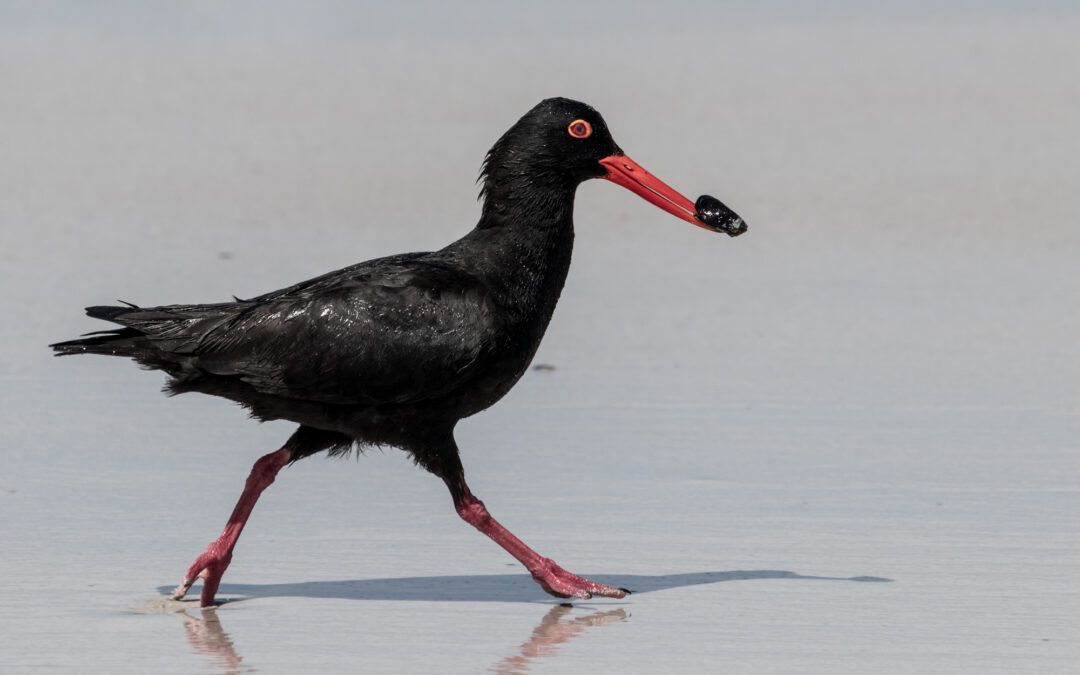
The Cape coast is a place where land and sea meet in a constantly changing landscape of rocky shores, sandy beaches, tidal pools, estuaries, lagoons and coastal wetlands. These habitats support an extraordinary variety of birdlife. Among the most familiar species are two very different birds: the African oystercatcher and the Egyptian goose. One is a specialised shorebird of the ocean edge, while the other is a versatile waterbird equally at home beside wetlands, rivers, dams and estuaries. Penguin Trail hikers are sure to meet both on their coastal hikes.
The African Oystercatcher – a Bird of the Shore
The African oystercatcher (Haematopus moquini) is one of the Cape coast’s most distinctive birds. With its entirely black plumage, bright orange-red bill and pinkish-red legs, it is difficult to confuse with any other South African coastal bird. Its clear, piping call often carries across the beach and rocky shoreline.
The species is endemic to southern Africa, breeding along the coast of South Africa and Namibia. The southwestern Cape is particularly important for the species, historically supporting a substantial proportion of the world’s population.
Despite its name, the African oystercatcher does not live exclusively on oysters. Its powerful, laterally compressed bill is ideally suited to feeding on a variety of intertidal organisms. Mussels, limpets and other marine invertebrates form an important part of its diet. At low tide, oystercatchers can be seen moving deliberately across exposed rocks, probing, prising and hammering at their prey.
The rhythm of their lives is therefore closely linked to the tides. When the sea covers the intertidal feeding grounds, the birds retreat to suitable roosting areas until the shoreline is exposed again.
Breeding on the Cape Coast
One of the most fascinating aspects of the African oystercatcher is its breeding behaviour. Unlike many birds that build elaborate nests, oystercatchers make a remarkably simple nest: a shallow scrape in sand, gravel or among coastal vegetation.
This apparently exposed nesting strategy makes them particularly vulnerable. Breeding generally takes place during the warmer months, when beaches and coastal areas are also heavily used by people. Research has shown that human disturbance, vehicles and uncontrolled dogs can damage nests or disturb adults caring for eggs and chicks.
The Cape coast therefore provides an important lesson in conservation. A nest may be almost invisible to a person walking along the beach, yet it can represent weeks of investment by a breeding pair.
Fortunately, conservation measures have helped the species. Restrictions on beach driving and greater public awareness have contributed to an increase in the African oystercatcher population since the early 1980s.
Today, seeing African oystercatchers along the Penguin Trail is a reminder of the value of undisturbed coastal habitat.
Egyptian Geese – From Wetlands to the Coast
A very different bird is the Egyptian goose (Alopochen aegyptiaca). Despite its common name, it is not a true goose in the strict taxonomic sense, but belongs to the duck family. It is a large, striking waterbird, easily recognised by its pale grey-brown body, darker patches around the eye and chest, and characteristic pinkish legs.
Egyptian geese are widespread across southern Africa and are remarkably adaptable. They favour wetlands with open water and nearby grassland or other areas where they can graze. Their preferred habitats include rivers, dams, lakes, and marshes. Remarkably, however, they have also adapted successfully to living along our coastal shores, and Penguin Trail hikers will encounter them along with our other shorebirds.
They are largely vegetarian, feeding on grasses, shoots, seeds and other plant material. They may also consume aquatic vegetation and occasionally small invertebrates. Their ability to exploit both natural and modified habitats has helped make them one of the most familiar large waterbirds in the region.
Life Beside the Water
Egyptian geese are conspicuous birds. Pairs and family groups often remain together, and their loud calls can make their presence known long before they are seen. They spend time both on the water and grazing on adjacent grasslands, demonstrating how closely linked wetland and terrestrial habitats can be.
Their adaptability contrasts strongly with the specialised lifestyle of the African oystercatcher. An oystercatcher depends on a healthy intertidal zone and suitable undisturbed nesting sites, whereas an Egyptian goose can make use of a much wider variety of habitats.
Yet both depend on clean, functioning water systems and suitable open spaces.
Two Birds, One Coast
The African oystercatcher and Egyptian goose represent two very different ecological worlds. The oystercatcher belongs to the wave-washed rocks, mussel beds and sandy beaches of the open coast. The Egyptian goose belongs more naturally to freshwater, but happily coexists with the oystercatchers and other shorebirds along our beaches and rocky shores. The Cape’s mosaic of beaches, rocky shores, lagoons, rivers and wetlands is precisely what makes the region so rich in birdlife.
For Penguin Trail hikers, these two species are excellent reminders that birdwatching does not always require a special reserve or remote wilderness. An African oystercatcher standing above the tideline or a family of Egyptian geese cruising around a coastal rock pool can reveal something important about the landscape. They are part of the living character of the Cape coast. Protecting the habitats they depend upon ensures that these familiar and fascinating birds will continue to be part of the Cape’s natural heritage.