
Nestled between the rugged mountains and pristine coastline of the Western Cape, the Kogelberg Biosphere Reserve is celebrated as the heart of the Cape Floristic Region. While the spectacular proteas, colourful ericas, and graceful restios often steal the spotlight, another group of plants quietly flourishes beneath the fynbos canopy. The orchids of the Kogelberg are among the region’s most fascinating botanical treasures, rewarding patient observers with intricate flowers, remarkable adaptations, and extraordinary beauty.
Unlike the large tropical orchids familiar from florists and garden centres, the orchids of the Kogelberg are generally small, delicate, and often easily overlooked. Their subtle charm is perfectly suited to the wild fynbos landscape, where survival depends on adaptation to nutrient-poor soils, seasonal rainfall, and periodic fires.
A Biodiversity Hotspot
The Kogelberg is widely regarded as the finest example of mountain fynbos in the world. Covering approximately 100,000 hectares, it supports more than 1,800 plant species, many of which occur nowhere else on Earth. This exceptional diversity extends to its orchids, with dozens of species found throughout the reserve.
The cool Mediterranean climate, varied mountain slopes, sandstone soils, wetlands, and seasonal seeps create numerous specialised habitats where different orchid species thrive. Many have evolved to occupy extremely narrow ecological niches, making them both rare and highly sensitive to environmental change.
Masters of Disguise
One of the remarkable features of Kogelberg orchids is their diversity of form. Some produce brilliant spikes of crimson, yellow, white, or pink flowers, while others blend almost perfectly into the surrounding vegetation.
Many species emerge only during a short flowering season, spending much of the year hidden underground as tubers. After the winter rains arrive, fresh leaves appear before flowering begins in spring or early summer. Once seeds have matured, the visible parts die back, leaving the underground tubers to survive the dry summer months.
This seasonal lifestyle allows orchids to cope with the challenging Mediterranean climate of the Cape.
The Spectacular Disa
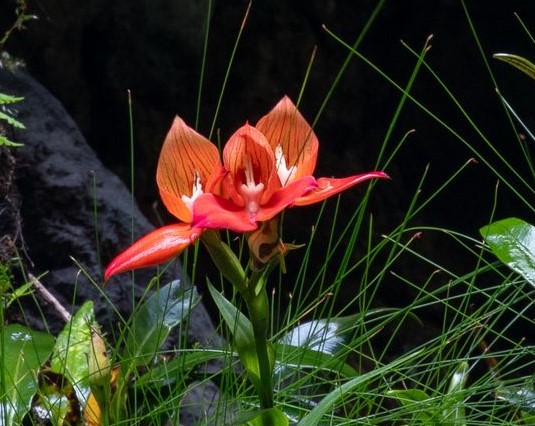
Perhaps the best-known Cape orchid is the magnificent Disa uniflora, commonly known as the Pride of Table Mountain. Although best known from Table Mountain streams, it also occurs in suitable mountain habitats within the Kogelberg where permanent seepages and cool streams provide the damp conditions it requires.
Its vivid scarlet flowers are among the most striking in South Africa. Unlike many orchids that attract bees, Disa uniflora relies almost exclusively on the Mountain Pride butterfly for pollination, demonstrating one of the most specialised plant-pollinator relationships in the Cape Floristic Region.
Other members of the Disa genus display white, pink, yellow, or purple flowers, each adapted to different pollinating insects and environmental conditions.
Ingenious Pollination Strategies
Orchids are famous for their sophisticated pollination mechanisms, and Kogelberg species are no exception.
Rather than producing abundant nectar, many orchids rely on deception. Some imitate rewarding flowers to attract bees or flies without offering food. Others mimic female insects, enticing males to attempt mating with the flower and inadvertently transfer pollen.
Certain species emit scents that closely resemble those produced by insects or decaying organic matter, attracting highly specialised pollinators. These extraordinary evolutionary adaptations ensure that pollen is transferred efficiently between flowers while minimising wasted effort.
The close relationship between orchids and their pollinators means that conserving insect populations is just as important as protecting the plants themselves.
Fire and Renewal
Fire plays a vital role in maintaining healthy fynbos ecosystems. Although destructive at first glance, periodic fires remove old vegetation, recycle nutrients, and create ideal conditions for many orchid species.
Following a burn, sunlight reaches the soil surface, competition from shrubs is temporarily reduced, and dormant orchid tubers often respond with vigorous growth and spectacular flowering displays. Some species may remain almost invisible for years before suddenly carpeting recently burnt slopes with blooms.
This natural cycle highlights why carefully managed fire regimes are essential for maintaining the biodiversity of the Kogelberg.
Tiny Plants with Complex Lives
Although orchids produce thousands of microscopic seeds, successful germination is surprisingly difficult.
Unlike most plants, orchid seeds contain almost no stored food. Instead, they depend on specialised soil fungi that provide nutrients during the earliest stages of growth. This intimate partnership continues throughout much of the orchid’s life and explains why many species are extremely difficult to cultivate outside their natural habitats.
Healthy soils, intact fungal communities, and undisturbed vegetation are therefore critical for the long-term survival of Kogelberg orchids.
Finding Orchids in the Wild
The best flowering period generally falls between late winter and early summer, depending on rainfall, altitude, and individual species. Penguin Trail hikers walking the trail from the Oudebosch office to the Harold Porter Gardens in spring should find flowering orchids in the fynbos. Because many flowers stand only a few centimetres above the ground, walking slowly and scanning carefully greatly increases the chances of spotting them.
A Reward for the Observant Hiker
The orchids of the Kogelberg may lack the size and flamboyance of their tropical relatives, but they possess a quiet elegance that perfectly reflects the spirit of the Cape fynbos. Their intricate flowers, ingenious biology, and remarkable resilience make them some of the most captivating plants in South Africa’s richest botanical landscape.
For Penguin Trail hikers, discovering a wild orchid tucked among the mountain fynbos is a memorable experience. These hidden jewels remind us that the greatest wonders of the Kogelberg are often found not in sweeping vistas, but in the smallest details beneath our feet.