
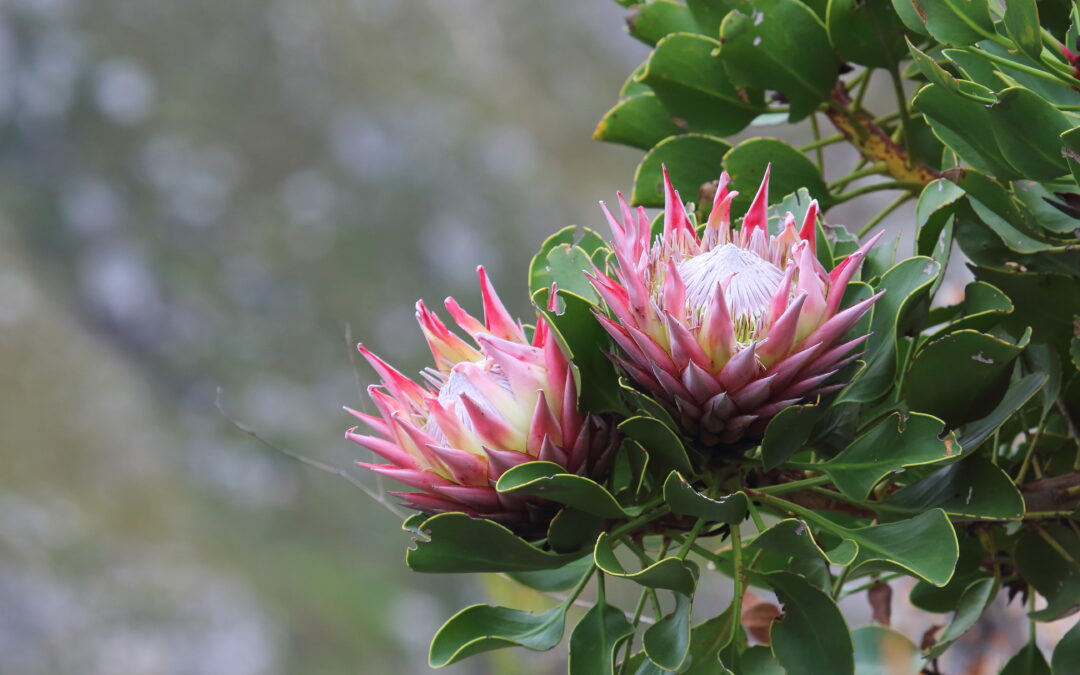
The Kogelberg Biosphere Reserve is often described as the heart of the Cape Floral Kingdom. Among its greatest botanical treasures are the proteas — striking flowering shrubs that have become symbols of South Africa’s extraordinary biodiversity. Hikers walking the Penguin Trail in the spring months are sure to see a variety of flowering proteas.
To walk through the Kogelberg during the flowering season is to enter a landscape alive with colour, texture, and life. Proteas rise from the fynbos like natural sculptures, their large blooms attracting birds, insects, and admirers from around the world. More than just beautiful flowers, they are key players in one of the richest floral regions on Earth.
What makes the Kogelberg so special is its astonishing plant diversity. More than 1,800 plant species occur here, and many of them are found nowhere else in the world. The combination of varied soils, altitude changes, winter rainfall, and relative isolation has created ideal conditions for proteas and other fynbos plants to flourish.
What are proteas?
Proteas belong to the family Proteaceae, an ancient group of flowering plants that evolved millions of years ago. The name comes from the Greek god Proteus, who could change shape — a fitting reference to the remarkable variety of forms found within the genus.
In the Kogelberg, proteas range from low-growing shrubs hugging rocky slopes to tall bushes crowned with dramatic flower heads. Their blooms can be pink, red, cream, yellow, or white, and many have a distinctive waxy texture that helps them survive the region’s dry summers.
Notable protea species in the Kogelberg
King Protea (Protea cynaroides)
The King Protea is South Africa’s national flower and one of the most recognisable proteas in the world. Its enormous flower head, sometimes larger than a dinner plate, makes it a spectacular sight in the wild. In the Kogelberg, it often appears on well-drained mountain slopes, where its pink bracts stand out against the muted greens of the fynbos.
Sugarbushes
Several species of sugarbushes occur in the Kogelberg. These proteas produce nectar-rich flowers that are especially attractive to birds such as the Cape sugarbird and various sunbird species. Their presence adds movement and sound to the landscape as birds flit from bloom to bloom.
Pincushion Proteas (Leucospermum species)
Although technically not all are in the genus Protea, pincushion proteas are close relatives and are among the most visually striking plants in the region. Their bright orange and yellow flower heads resemble fireworks frozen in time.
Conebushes (Leucadendron species)
Conebushes add another layer of diversity. Male and female plants often differ in appearance, and their colourful foliage can be just as attractive as their flowers.
A vital part of the fynbos ecosystem
Proteas are not merely ornamental. They play an essential ecological role in the Kogelberg. Many proteas are pollinated by birds, particularly the Cape sugarbird and orange-breasted sunbird. Their long beaks are perfectly adapted to reach deep into the flowers. The nectar produced by proteas supports a range of insects and birds. Dense protea shrubs provide shelter for small animals and birds.
Fynbos is a fire-dependent ecosystem. Many protea species have evolved strategies to survive periodic fires, such as storing seeds in woody cones that open after a burn. After a fire, the Kogelberg often experiences a remarkable resurgence of proteas. Young plants emerge from the ash-rich soil, ensuring the continuation of the species.
When to see proteas in bloom
Proteas can be seen throughout much of the year, but the best flowering displays generally occur from late winter to spring, roughly between August and November. Different species bloom at different times, so there is often something flowering in every season.
Enjoying the Kogelberg’s beautiful protea display is just one of many things for our Penguin Trail hikers to enjoy!