
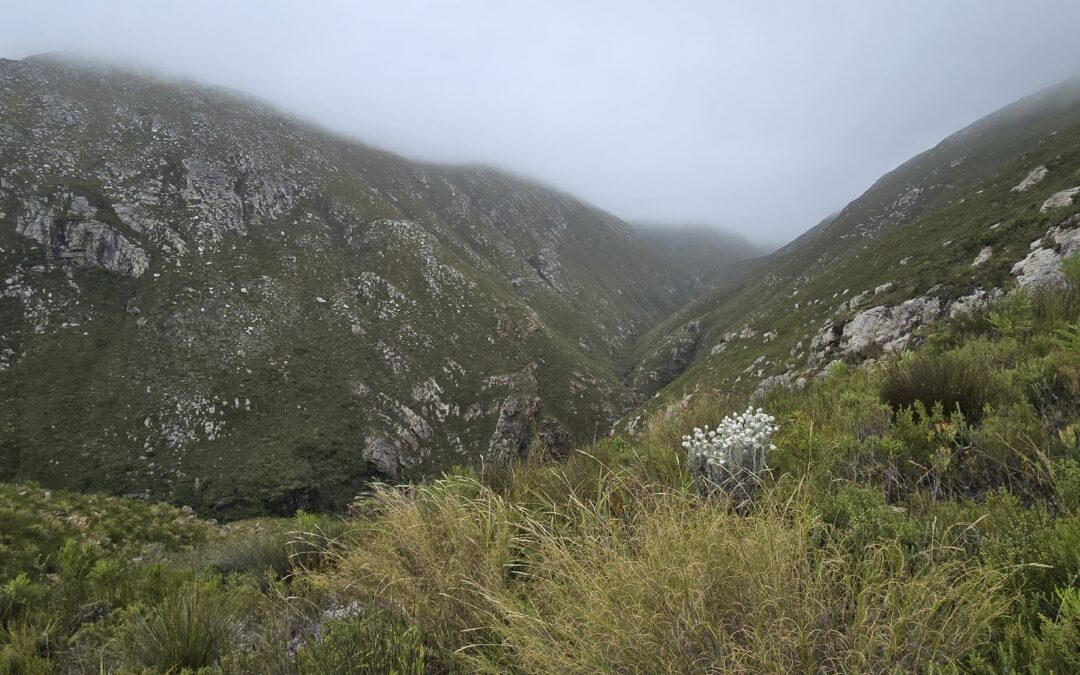
Our Penguin Trail comprises a mix of coastal and mountain hikes, affording Penguin Trail hikers the opportunity to enjoy our beautiful Kogelberg fynbos.
The Kogelberg is often described as the heart of the Cape Floral Kingdom, and with good reason. Stretching from the dramatic coastline between Gordon’s Bay and Kleinmond into the rugged mountains overlooking the Atlantic Ocean, this remarkable landscape contains one of the richest concentrations of plant diversity on Earth.
Designated as a UNESCO World Heritage Site as part of the Cape Floral Region Protected Areas, the Kogelberg is regarded by botanists as the finest example of mountain fynbos in the world. It is a living museum of plant evolution, where thousands of species have adapted over millions of years to survive in nutrient-poor soils, seasonal droughts, strong coastal winds and regular fires.
What is Fynbos?
The word fynbos is Afrikaans for “fine bush,” referring to the fine, needle-like leaves of many of its shrubs. Despite the name, fynbos is not a forest or a single type of plant but a unique vegetation community made up of thousands of different species.
The Cape Floral Kingdom is the smallest of the world’s six floral kingdoms, yet it contains an astonishing diversity of plant life. Although it occupies less than one percent of Africa’s land area, it is home to nearly 9,000 plant species, with almost 70 percent found nowhere else on Earth.
The Kogelberg represents the very best of this biodiversity. More than 1,800 plant species have been recorded within the reserve, many of them endemic to the area. Some grow only on a single mountain slope or in one isolated valley, making their conservation critically important.
A Landscape Shaped by Nature
The rugged mountains of the Kogelberg were formed from ancient Table Mountain Sandstone over 450 million years ago. Over countless millennia, wind, rain and rivers carved steep valleys and towering peaks that today create a remarkable range of habitats.
The area’s acidic, nutrient-poor soils may appear inhospitable, yet they have encouraged plants to develop specialised survival strategies. Many species have small, leathery leaves that minimise water loss, while others have deep root systems or underground storage organs that enable them to survive long dry summers.
Altitude also plays an important role. Coastal plains, mountain slopes, wetlands, rocky cliffs and river valleys each support their own distinctive plant communities, contributing to the area’s exceptional biodiversity.
The Iconic Plants of the Kogelberg
Perhaps the most recognisable members of the fynbos are the proteas. Their spectacular flower heads attract birds, insects and small mammals, making them essential components of the ecosystem. The King Protea, South Africa’s national flower, occurs within the region, alongside numerous other species displaying an impressive range of colours and forms.
Equally important are the ericas, or heaths. The Kogelberg is considered one of the world’s centres of diversity for this remarkable plant group. Hundreds of Erica species produce delicate tubular flowers in shades of pink, red, orange and white, providing nectar for sunbirds and insects throughout much of the year.
Completing the classic fynbos trio are the restios. Although often mistaken for grasses, these ancient reed-like plants belong to an entirely separate family. They dominate many mountain slopes and wetlands, adding texture and movement to the landscape while playing an important ecological role in stabilising soils.
Bulbous plants flourish after seasonal rains, with irises, gladioli, watsonias and orchids producing brilliant displays of colour. During spring, entire hillsides may burst into bloom, creating one of South Africa’s finest wildflower spectacles.
Fire: A Vital Part of the Ecosystem
To many people, wildfire represents destruction. In the Kogelberg, however, fire is a natural and essential ecological process.
Most fynbos plants have evolved alongside periodic fires for millions of years. Many species rely on fire to trigger seed release or stimulate germination. Some plants store seeds safely within woody cones until the heat opens them, while others regenerate rapidly from underground stems after a fire has passed.
Without occasional fires, older vegetation becomes overcrowded and less diverse. Carefully managed natural fire cycles help maintain the remarkable richness of plant species that defines the Kogelberg.
Wildlife Among the Fynbos
Although famous for its plants, the Kogelberg also supports a fascinating variety of wildlife.
The brightly coloured Cape Sugarbird and several species of sunbirds are among the most important pollinators of proteas and ericas. Their long curved bills allow them to feed on nectar while transferring pollen between flowers.
Small mammals such as dassies, mongooses and Cape grysbok inhabit the mountains, while baboons forage across the rocky slopes and valleys. Leopards, although rarely seen, still survive in the remote mountain wilderness.
The rivers flowing through the reserve support indigenous fish species, while wetlands provide habitat for frogs, dragonflies and numerous aquatic insects. The diversity of insects alone is extraordinary, with many species existing nowhere else.
Experiencing the Kogelberg Fynbos
Visitors have numerous opportunities to experience the beauty of the Kogelberg fynbos. Our Penguin Trail is undoubtedly a choice option, with opportunity to enjoy both coastal and mountain fynbos. Spring is generally regarded as the finest season for wildflowers, although the Kogelberg offers botanical interest throughout the year. Every season reveals different flowering species, ensuring that no two visits are ever quite the same.
Come and enjoy a walk in the Garden of Eden!