
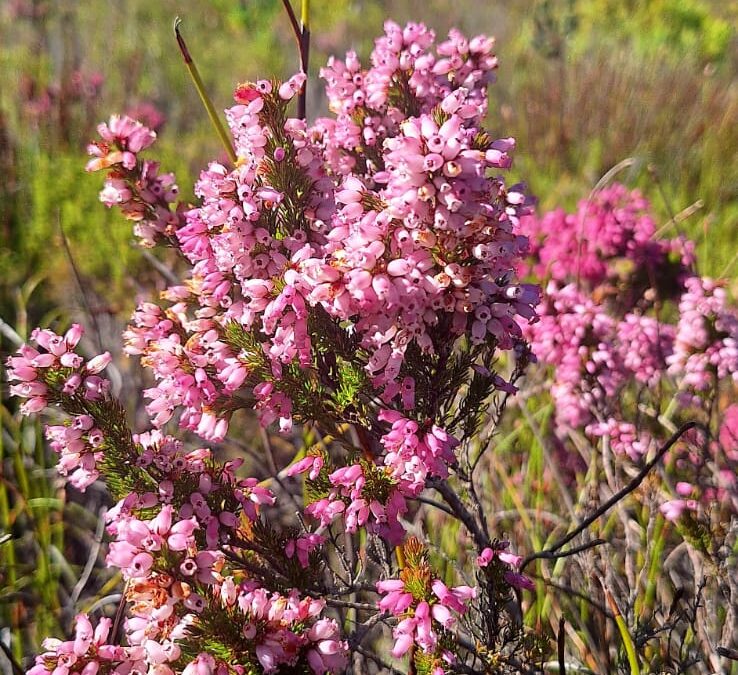
The Kogelberg is widely regarded as the heart of South Africa’s Cape Floral Kingdom. This extraordinary wilderness boasts the greatest concentration of plant species of any temperate region on Earth. While proteas often steal the spotlight, another remarkable group of plants quietly creates one of the Kogelberg’s most spectacular floral displays: the ericas.
With more than 650 species found in South Africa—many of them endemic to the Cape Floristic Region—the genus Erica reaches its greatest diversity in the mountains and valleys of the Kogelberg. Hiking through this UNESCO-designated Biosphere Reserve reveals a breathtaking variety of colours, shapes and sizes, making the region a paradise for botanists, photographers and nature lovers alike. Our Penguin Trail hikers are able to enjoy this magnificent display.
A World Centre for Erica Diversity
Although ericas occur across Europe and other parts of Africa, nowhere on Earth compares with the Cape for diversity. The Kogelberg alone is home to well over 150 species, many of which grow nowhere else.
These remarkable plants have evolved over millions of years to occupy every available niche. Some form compact cushions hugging rocky slopes, while others grow into shrubs over two metres high. Their flowers range from tiny white bells to brilliant red tubes, delicate pink lanterns and vivid orange blooms.
The extraordinary variety reflects the complex geology, varied rainfall, altitude and fire cycles that characterise the Kogelberg. Different species may be found on sandstone ridges, damp seeps, mountain summits, shaded ravines or coastal flats.
Beautiful Adaptations
The flowers of ericas are masterpieces of natural engineering. Most possess tubular or bell-shaped flowers specifically adapted to attract certain pollinators.
Many red-flowered species rely on Cape Sugarbirds and Orange-breasted Sunbirds, whose long curved bills reach deep into the flowers to collect nectar. As the birds feed, pollen dusts their heads and is transferred to the next flower.
Smaller white or pink species are often pollinated by bees and insects, while a few emit delicate fragrances that attract moths after sunset.
These specialised relationships have driven the remarkable diversification of the genus throughout the Cape.
Fire: Essential for Survival
Like much of the fynbos vegetation, ericas are intimately adapted to periodic fires.
Although wildfire may appear destructive, it is essential for maintaining healthy fynbos ecosystems. Many erica species regenerate from seeds that germinate after fire, while others resprout from underground rootstocks.
Without occasional fires, taller shrubs gradually dominate the landscape, reducing the diversity that makes the Kogelberg so exceptional. Fire clears old vegetation, releases nutrients into the soil and creates open spaces where young ericas can establish themselves.
The timing and frequency of fires are crucial. Fires occurring too frequently may prevent young plants from reaching maturity, while fires that are too infrequent allow vegetation to become senescent.
Notable Erica Species
One of the delights of exploring the Kogelberg is encountering different erica species throughout the year.
The elegant Erica discolor produces graceful sprays of pink to cream flowers that brighten mountain slopes during winter and spring.
Erica plukenetii, with its long scarlet tubular flowers, is a favourite of sunbirds. Several colour forms occur across the Kogelberg, illustrating the remarkable variability within a single species.
The striking Erica mammosa bears large, inflated red flowers that make it one of the easiest species to recognise.
Tiny species such as Erica imbricata reward careful observation, producing masses of miniature blossoms that transform rocky outcrops into colourful carpets.
Because flowering times differ between species, visitors can find blooming ericas during almost every month of the year.
Seasonal Displays
Winter and spring are generally regarded as the finest seasons for viewing ericas in flower. Following the first winter rains, hillsides come alive with countless blooms in shades of white, pink, crimson, orange and purple.
However, the Kogelberg offers floral interest throughout the year. Summer-flowering species thrive in higher mountain areas, while autumn brings fresh displays in sheltered valleys and moist habitats.
This succession of flowering ensures a continuous supply of nectar for birds and insects, sustaining one of the world’s richest pollinator communities.
A Living Treasure
The ericas of the Kogelberg represent far more than beautiful wildflowers. They tell the story of millions of years of evolution, intricate ecological relationships and the extraordinary resilience of the Cape Floristic Region.
Their dazzling diversity reminds us why the Kogelberg is often called the “heart of the fynbos.” Whether viewed from a mountain trail, photographed in morning light or admired by a passing sunbird, these elegant shrubs embody the unique natural heritage of South Africa.
For Penguin Trail hikers, taking time to appreciate the Kogelberg ericas adds a new dimension to the experience. Beyond their delicate beauty lies one of the richest concentrations of plant diversity anywhere on Earth.